If you’ve checked your search rankings lately and felt like something’s off, you’re not imagining it. For a growing number of queries, the first thing people see isn’t a blue link anymore — it’s an AI-generated summary sitting above every organic result. That’s Google’s AI Overview, and it’s quietly rewriting rules that have held for two decades of SEO.
In this guide, we’ll walk you through what AI Overviews actually are, what the data says about their impact on your clicks and rankings, and exactly what you can do to stay visible as search shifts from a “rank and click” model to a “get cited or get skipped” one.
Let’s get into it.
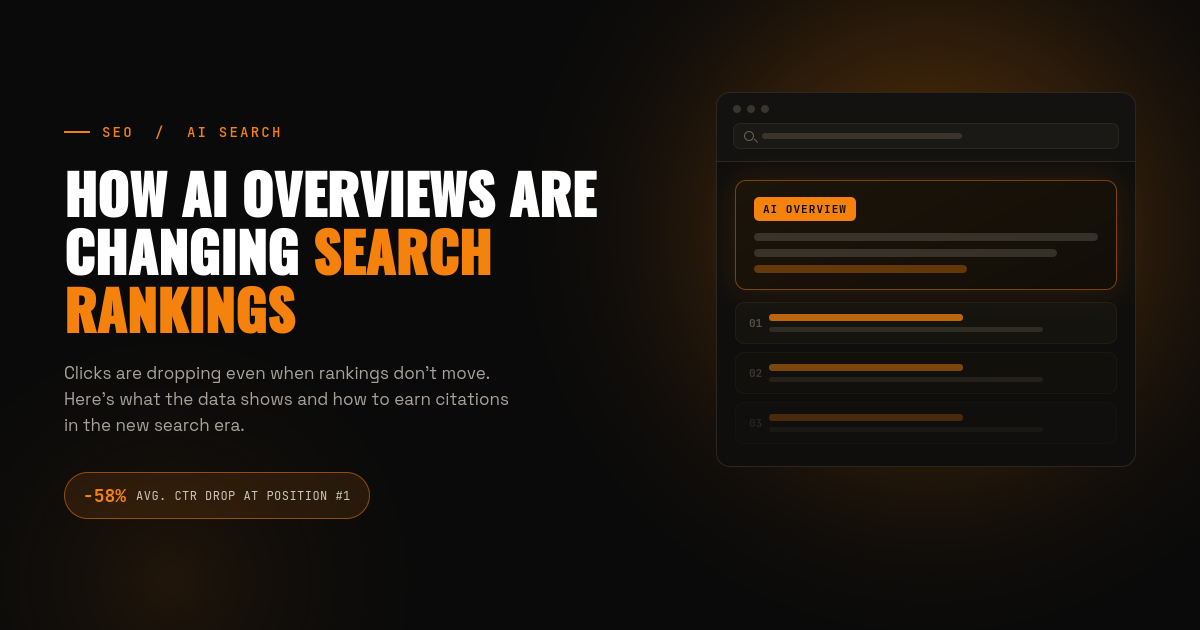
AI Overviews are AI-generated answer summaries that show up at the top of Google’s results, above the traditional organic listings. Instead of sending people straight to a list of links, Google’s AI reads across multiple web sources, pulls the relevant information together, and hands users a ready-made answer — usually with a few source links attached.
They’re part of Google’s broader push into generative search (you may have seen this called the Search Generative Experience, or SGE), and they now show up across 100+ countries and dozens of languages. Google’s own Search Central documentation on AI features is pretty clear on this point: there are no separate ranking requirements for AI Overviews. The same SEO fundamentals that apply to regular organic Search still decide whether your page gets surfaced or cited.
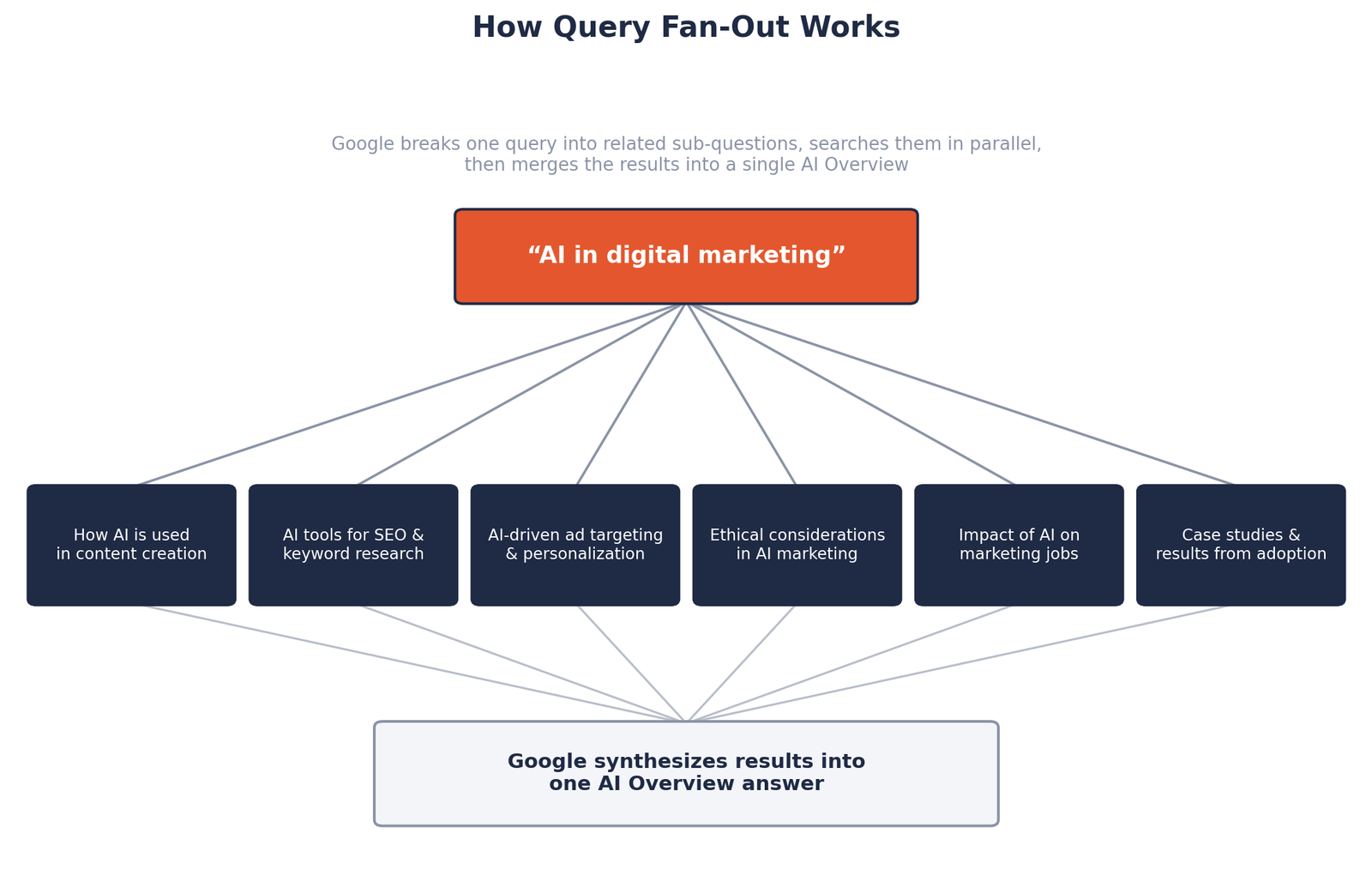
Here’s something worth understanding before you optimize a single page: AI Overviews don’t just answer the exact query someone typed. When Google builds one, it breaks that query into a cluster of related sub-questions, searches for each of them at once, and then stitches the results into one coherent answer. This is called query fan-out.
Say someone searches “AI in digital marketing.” That query might fan out into questions like:
This matters more than it might seem, because it means Google isn’t just judging your one page — it’s judging whether your whole site covers a topic well enough to answer several related questions at once.
Generated summary
A short, synthesized answer pulling from multiple sources
Source links
Clickable citations to the pages used to build the answer
Follow-up questions
Suggested related queries that keep users inside Google
Commercial modules
Product or service recommendations, where relevant
Before you start optimizing, it helps to know there isn’t just one type of visibility to chase here — there are two, and they work differently.
What it is
Your page is directly linked as a source
Your brand, product, or site is named in the AI-generated text
Clickable?
Yes — usually a small card or link
Not necessarily
Primary value
Referral traffic, credibility signal
Brand awareness, recall, future branded searches
How you earn it
Structured, citable, authoritative content
Strong off-page presence, brand consistency, being "known" for a topic
Both are worth going after. A citation can drive an actual click. A mention builds the kind of brand familiarity that shows up later as a branded search or a direct visit — even if nobody clicked today.
This is the part that should really shape your expectations. Multiple independent studies have tracked what happens to organic click-through rate (CTR) once an AI Overview appears on a results page, and the pattern holds up again and again: clicks go down, even when your rankings don’t move at all.
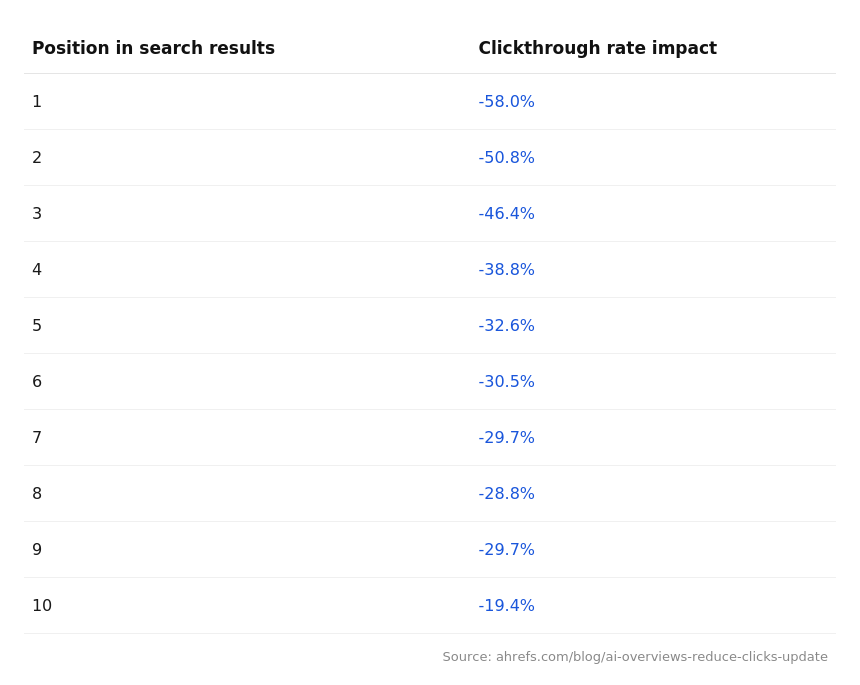
So even if you’re not ranking #1, you’re still losing clicks any time an AI Overview shows up anywhere on that page.
Here’s a pattern a lot of site owners are running into — and misdiagnosing:
Put together, that can look like a content problem or a ranking issue. Usually, it isn’t. AI Overviews push traditional listings further down the page, especially on mobile, so even a page that’s technically “ranking well” now sits below a large AI-generated block that’s already answered the query before anyone scrolls.
What this means for your reporting: ranking position alone doesn’t tell you how much traffic a keyword can realistically deliver anymore. You need to look at CTR by query type, and whether that query triggers an AI Overview at all. Honcho’s breakdown of exactly this pattern in Search Console data is worth a read if you’re trying to explain the gap to stakeholders.
AI Overviews are the latest — and most aggressive — entry in a long line of Google features (Featured Snippets, the Local Pack, Top Stories) built to answer queries without anyone clicking. The result is an accelerating rise in zero-click search: people get what they need right there on the results page and never visit a website at all.
That doesn’t mean visibility is worthless — it means the value exchange has changed. Getting cited in an AI Overview can still build brand authority, voice-search presence, and assisted conversions, even for people who never click through to you.
The people who do still click past an AI Overview tend to want something more specific — deeper detail, a comparison, validation, or a transactional next step. So the traffic you’re left with is often more qualified, even if there’s less of it: smaller in volume, but closer to a decision.
AI systems are built on language patterns, not keyword-matching. Content that’s logically structured, written in plain language, and organized around real sub-questions will consistently outperform content stuffed with keyword variations.
AI Overviews favor short, self-contained passages that answer a query directly. A few ways to build this into your pages:
Google’s AI needs to understand what your content is about — not just which keyword you’ve repeated the most. Pages that naturally include the terms and concepts search engines associate with a topic (for local SEO, think Google Business Profile, NAP consistency, local citations, customer reviews) signal topical relevance far more effectively than keyword repetition ever will.
AI can’t replicate what it hasn’t seen anywhere else. Content built on real results, original data, case studies, or first-hand testing carries outsized value, simply because it can’t be synthesized from existing web content the way generic advice can.
Since AI Overviews are almost entirely text, visuals are one of the few things they genuinely can’t reproduce. Screenshots, infographics, charts, and short explainer videos give people (and the systems evaluating “helpfulness”) a real reason to still visit your page.
We’ll walk you through each step here — from identifying which keywords already trigger AI Overviews, to fine-tuning your content for AI readability, implementing structured data, and building the off-page trust signals that tie it all together. This follows the same underlying approach Seobility recommends, expanded with the schema, measurement, and off-page context above.
Before your content can be summarized, it has to be crawled and understood in the first place.
Schema won’t directly boost your rankings, but it helps machines correctly categorize your content — and that matters more, not less, in an AI-summarization environment.
| Schema Type | Use For |
| FAQPage | Pages with lists of questions and answers |
| HowTo | Step-by-step tutorials or instructions |
| Article | Blog posts and informational content |
| Organization | Business/brand identity information |
| Person | Individual author or expert profiles |
| Product | Product pages or reviews |
| Dataset | Original research or data-driven content |
Since Google’s AI breaks queries into related sub-questions, your site structure should mirror that same breakdown.
Do this well and you signal topical authority, which increases the odds that several pieces of your content get pulled into a single AI-generated answer.
Rethinking SEO Measurement for the AI Overview Era
Ranking position alone doesn’t predict traffic potential anymore. To read your performance accurately, you’ll want to track:
One limitation worth knowing about: there’s still no fully reliable, direct way to see whether a specific page was used as a source inside an AI Overview. Right now, the best you can do is infer impact from patterns in impressions, clicks, and CTR in tools like Search Console, alongside whatever AI Overview tracking your SEO platform offers.
AI Overviews have changed what “ranking well” even means. Being on page one isn’t enough anymore if your content isn’t structured to be cited. Getting there takes a mix of technical SEO, schema markup, topic clusters, and content that’s genuinely built for how AI systems extract and summarize answers.
If you’re not sure where your content stands today — or you’ve noticed impressions holding steady while your clicks quietly slide — we can help you figure out exactly why, and fix it.
Contact Us to get an AI Overview readiness audit for your website.


Yes, in most cases — especially for informational queries where an AI-generated summary can fully satisfy someone’s intent without a click. Studies consistently show CTR declines in the 47–65% range for queries where an AI Overview appears.
AI Overviews keep your page eligible to appear (impressions), but they reduce the need to actually click through, since the answer is often already sitting right there on the results page.
Yes. SEO isn’t going away — its job is just expanding. Ranking well is still the prerequisite for being considered as a source, but structure, clarity, originality, and trust signals now matter just as much as traditional ranking factors.
Both — but they’re not the same thing anymore. Ranking on page one used to be the finish line. Now it’s more like a qualifying round: the real competition is whether your content is structured, credible, and specific enough to actually be the thing Google’s AI pulls from.

Your customers are already searching on Google, ChatGPT, Gemini, Claude, and Perplexity. The question is whether they'll find your business or your competitors.
At Sntrix, we help ambitious brands dominate traditional search and AI-powered discovery with data-driven SEO, AEO, GEO, conversion-focused content, and high-performance websites.
H&H Business Arcade,
D-141, Sector 73 Mohali, Punjab 140308
10333 Richmond Ave. ste 1000, Houston, TX 77042, United States
H&H Business Arcade,
D-141, Sector 73 Mohali, Punjab 140308